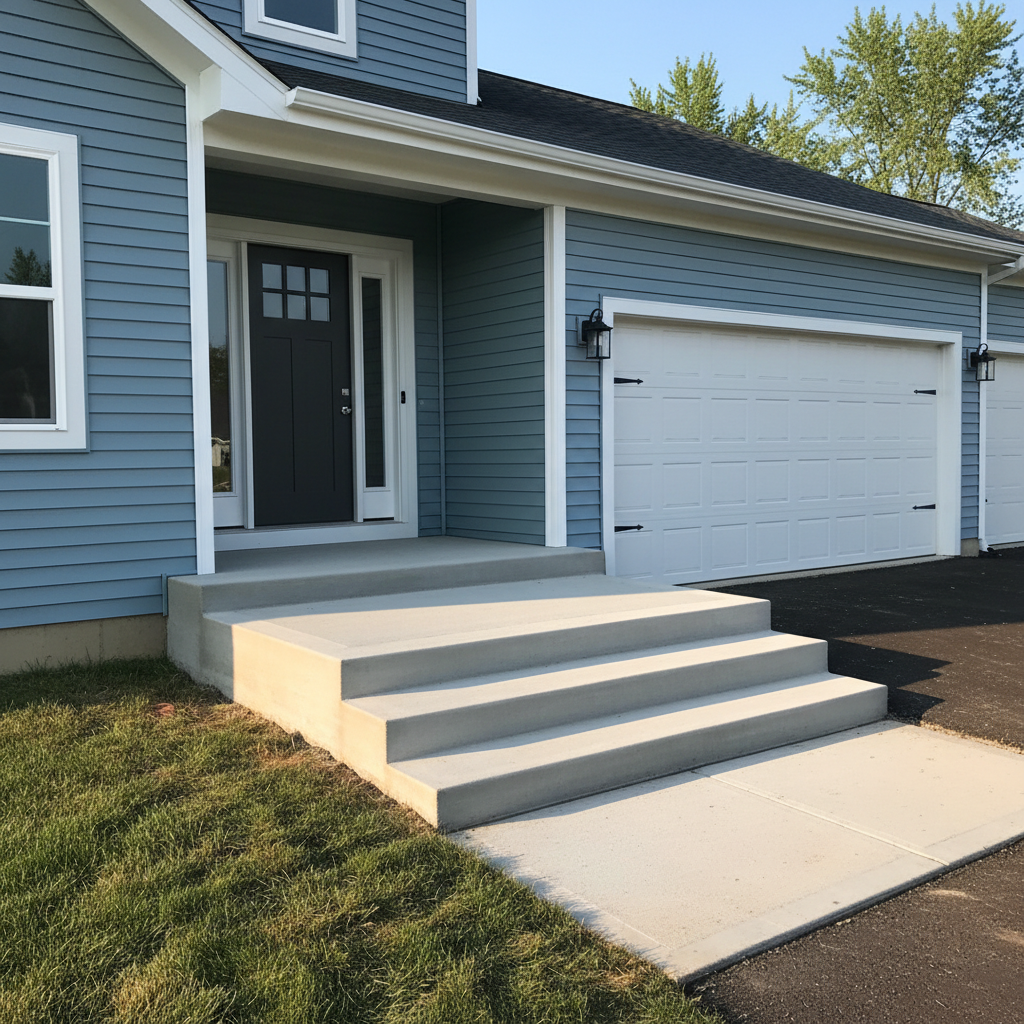
You call three or four contractors, you get three or four prices that don't match, and none of the quotes look like they're describing the same job. That's normal in this trade. The hard part isn't finding someone who'll pour concrete. It's telling the one who'll still look good in fifteen years from the one who'll crack and heave by the second winter.
Here's what actually separates those two, and what to look for before you sign anything.
What the ground around Goshen does to a slab
Elkhart County sits on heavy glacial clay till. When it's wet, that clay holds water and swells. When it dries out in a hot July, it shrinks and pulls away. That movement is the single biggest reason concrete fails here, more than the mix, more than the finish work. A slab poured straight onto that native clay, without a proper gravel base underneath, is going to move with the soil, and the concrete will crack where the soil tells it to, not where you want it to.
A contractor who knows this area compacts 4 to 6 inches of crushed stone before anything gets poured, and compacts it in lifts, not just dumps it and runs a plate over the top once. That base layer gives water somewhere to go besides under your slab. Ask how deep the base is going to be. If the answer is vague, that's your first clue.
Frost is the other factor. Around here the frost line typically runs 30 to 36 inches down, which is why footings for a foundation or an attached porch need to go below that depth, not just deep enough to look buried. A footing that sits above the frost line will heave with the freeze-thaw cycle every winter from November through March, and it'll keep doing it until someone digs it out and does it right.
Read the quote like it's a materials list, not a price
Two bids that are $1,500 apart might be describing two completely different products. A real quote should tell you the slab thickness in inches, not just the square footage. A patio or sidewalk is usually 4 inches. A driveway that'll see a car every day should be closer to 5, and if it's going to carry a delivery truck or an RV, thicker still, that's a real conversation to have given how many driveways around Goshen end up parking something heavier than a sedan.
It should also say whether you're getting rebar or wire mesh, and where. A driveway or garage floor holds up better with rebar, typically 1/2 inch rebar set on an 18-inch grid, tied and lifted off the base so it sits in the middle of the slab instead of the bottom. Mesh has its place on lighter slabs but it gets stepped on during the pour more often than it should, which puts it exactly where it does the least good.
Ask about air entrainment too. Concrete that's going to sit outside through Michiana winters needs air entrained into the mix, usually in the 5 to 7 percent range, so there's room for water inside the concrete to expand when it freezes instead of blowing the surface apart. Skip that and you'll see the surface start flaking and spalling within a couple of winters, especially anywhere road salt gets tracked onto a driveway or garage slab.
Last thing to check: control joints. These are the cut lines that tell a slab where to crack instead of leaving it to crack wherever it wants. For a 4-inch slab, joints should land roughly every 8 to 10 feet, cut within 24 hours of the pour while the concrete is still green. If a contractor's plan has joints spaced 20 feet apart, or doesn't mention joint spacing at all, that's a problem waiting to show up as a random crack straight through your new patio.
Timing matters more than people think
The pour season around here really runs April through November. Concrete poured into frozen ground, or into a mix that's allowed to freeze before it cures, loses strength it never gets back, no matter how good it looks once it thaws. A contractor who pours in late fall or early spring should be talking about blankets, heated water in the mix, or pushing the schedule back a few days, not just hoping for the best.
Once it's poured, don't walk on it for at least 24 hours, keep vehicles off for about a week, and give it the full 28 days before you expect it to be at full strength. If someone tells you it's fine to park a car on it the next day, they're either wrong or not planning to be around when it cracks under the tire.
Permits, inspections, and the paperwork side
Inside city limits, the City of Goshen's building department is who you're dealing with for footings, foundations, and anything tied to the structure of the house. Out in the townships, that goes through Elkhart County instead. Either way, a footing or foundation job usually gets inspected before the concrete goes in, so the crew has to be ready for that step, not just plan around it. If your lot is close to a property line, a setback check is worth asking about before material shows up, especially on older in-town lots where the lines weren't always surveyed the way newer subdivisions are. Newer developments around town are more likely to have an HOA with its own rules about driveway finishes or patio placement, so it's worth a look at your covenants before you pick a stamped pattern or a color.
Older neighborhoods near downtown Goshen often have slabs and foundations going back 70 or 80 years, sometimes with no rebar at all, old clay drain tile underneath that a crew needs to know is there before they start digging. A newer subdivision off SR 15 or out toward the edge of town is a cleaner start, usually just clay fill over farmland, but that clay still behaves the same way it always has.
What should make you walk away
A few things are worth treating as deal-breakers. Anyone who insists on cash only and won't put a scope of work in writing. Anyone who can't produce proof of insurance when you ask. A quote that never mentions reinforcement, base depth, or joint spacing at all, just a square footage and a price. A plan to pour a new driveway directly over an old cracked one without breaking it up first, patching it, that just telegraphs every old crack straight up through the new surface within a year or two. And watch the grading, too, a slab poured dead level against your house with no slope away from the foundation is going to send water right back toward your basement. A patio or driveway should pitch away at roughly a quarter inch per foot, nothing dramatic, but it has to be there.
None of this is complicated once you know what to ask. It's just information most homeowners never get told before they're standing in their driveway wondering why it's cracked after two winters. If you want a straight answer about base depth, reinforcement, or timing for a job in Goshen or anywhere around Elkhart County, that's the kind of conversation Evergreen Concrete Company has with every homeowner before a shovel goes in the ground.